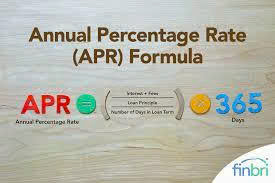
APR, short for Annual Percentage Rate, tells you how much it really costs to borrow money—or how much you earn—over the course of a year. It’s shown as a percentage and goes beyond just the interest rate by also factoring in certain fees and charges.
Because APR rolls multiple costs into one number, it makes it easier to compare loans, credit cards, and other financial products side by side. If you’ve ever wondered which credit card or loan is truly cheaper, APR is one of the most important numbers to look at.
Why APR Matters in Real Life
Imagine you’re choosing between two credit cards. One advertises a low interest rate, but the other has higher interest plus extra fees. APR helps reveal the true cost so you’re not misled by marketing claims.
In simple terms:
-
Lower APR = lower cost of borrowing
-
Higher APR = more expensive debt
That’s why APR disclosures are required by U.S. law—to help consumers make fair comparisons.
How APR Works (In Plain English)
APR represents the percentage of your loan balance you’ll pay each year, including:
-
Interest
-
Certain lender fees (like origination fees)
For example, if you borrow $5,000 with a 10% APR, you’ll pay about $500 per year in interest and fees—assuming you keep the balance for the full year.
APR uses simple interest, meaning it does not include the effect of interest compounding within the year.
APR and the Law: Why Lenders Must Disclose It
Under U.S. consumer protection laws, lenders are required to clearly show the APR before you agree to a loan or credit card. This prevents companies from advertising misleading monthly rates that sound low but turn out to be expensive when viewed annually.
Credit card companies, for example, may advertise monthly rates—but they must show the full APR before you sign up.
Common Types of APR You’ll See
Credit Card APRs
Credit cards often have multiple APRs, such as:
-
Purchase APR (regular spending)
-
Cash advance APR (usually much higher)
-
Balance transfer APR
-
Penalty APR (for late payments)
-
Introductory APR (often 0% for a limited time)
Each type applies to different transactions, so it’s important to read the fine print.
Fixed vs. Variable APR
-
Fixed APR: Stays the same over time (though it can still change under certain conditions).
-
Variable APR: Moves up or down based on market interest rates.
Most credit cards use variable APRs, while some personal loans offer fixed APRs.
How Your Credit Score Affects APR
Your credit score plays a big role in determining your APR. Borrowers with strong credit histories usually qualify for lower rates, while those with poor credit often face much higher APRs.
This means improving your credit score can save you thousands of dollars over time.
APR vs. APY: What’s the Difference?
APR and APY sound similar but mean different things:
-
APR shows simple interest (used for loans and credit cards).
-
APY includes compounding interest (used for savings accounts and investments).
Because APY accounts for compounding, it’s usually higher than APR.
Simple Example
If a credit card has a 12% APR and compounds monthly, your actual cost over a year is higher than 12%. APY reflects that extra cost—APR does not.
Why APR Doesn’t Tell the Whole Story
While APR is helpful, it isn’t perfect.
Some limitations include:
-
It spreads fees over the full loan term, which can understate costs for short-term loans.
-
It assumes interest rates stay the same, which isn’t true for adjustable-rate loans.
-
Different lenders may include different fees when calculating APR.
Because of this, APR should be used as a comparison tool—not the only factor in your decision.
What Is Considered a “Good” APR?
A good APR depends on:
-
Current market rates
-
The type of loan
-
Your credit score
For example:
-
Excellent credit may qualify for very low APRs, even 0% promotional offers.
-
Average or poor credit usually results in higher APRs.
Always check whether low APR offers are temporary or last for the full loan term.
How APR Is Calculated (At a High Level)
APR is based on:
-
Total interest paid
-
Fees charged
-
Loan amount
-
Length of the loan
You don’t need to calculate it yourself—lenders are required to show it clearly. Still, understanding what goes into APR helps you spot expensive loans.
Why APR Disclosure Protects Consumers
APR disclosures prevent lenders from hiding costs or confusing borrowers with misleading numbers. By forcing all lenders to use the same standard, consumers can make fair “apples-to-apples” comparisons between financial products.
Without APR rules, a loan could look cheap at first glance but cost much more over time.
The Bottom Line
APR is one of the most important numbers to understand when borrowing money. It shows the true yearly cost of a loan or credit card by combining interest and certain fees into one clear percentage.
While APR doesn’t include compounding or every possible cost, it’s still a powerful tool for comparing offers and avoiding expensive debt. Whenever you’re choosing a loan or credit card, always check the APR—and when possible, compare it alongside APY and other terms to make the smartest financial decision.