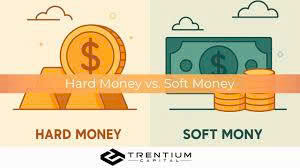
The terms hard money and soft money can be confusing because they’re used in different ways depending on the context. You may hear them in discussions about economics, finance, real estate, or U.S. politics—and the meaning changes slightly in each situation.
At a basic level, these terms describe how money is classified or used, whether it’s physical currency, a type of payment, or a political contribution. Let’s break it down in a simple, practical way.
Hard Money and Soft Money in Everyday Terms
In economics, the distinction is straightforward:
-
Hard money traditionally refers to money backed by something tangible, like gold or silver.
-
Soft money usually means paper currency that isn’t backed by a physical commodity and gets its value from government trust.
But outside of economics, these terms take on different meanings—especially in finance, real estate, and politics.
Hard Money vs. Soft Money in Politics
What Is Hard Money in Politics?
In U.S. elections, hard money refers to direct donations made to a specific political candidate or campaign.
These contributions are:
-
Strictly regulated by federal law
-
Limited in how much one person or group can give
-
Tracked and disclosed to the Federal Election Commission (FEC)
For example, if you donate money directly to a candidate running for Congress, that donation is considered hard money and must follow legal contribution limits.
Breaking these rules can lead to serious penalties, including fines or criminal charges.
What Is Soft Money in Politics?
Soft money is money donated to political parties or political groups, not directly to a candidate.
These contributions:
-
Can come from individuals, corporations, or organizations
-
Are not subject to the same strict dollar limits as hard money
-
Cannot legally be used to directly promote or oppose a specific candidate
Instead, soft money is used for broader activities like:
-
Voter registration drives
-
Party organizing
-
Promoting political ideas or causes
Because soft money can influence elections indirectly, it has been a major source of debate in campaign finance law.
Why Soft Money Is Controversial
Soft money is sometimes called a “loophole” because wealthy donors and corporations can contribute large sums that still affect elections—even without naming a candidate.
Court rulings have reinforced that this type of political spending is protected as free speech, but strict rules remain around coordination between candidates and the groups receiving soft money.
Hard Money and Soft Money in Finance
In the financial services industry, these terms describe how service providers are paid.
-
Hard money payments are direct and transparent, such as a fee you pay a financial advisor or broker.
-
Soft money payments are indirect, such as benefits or services provided through third parties that aren’t always clearly disclosed to clients.
Because soft money arrangements may not be obvious to customers, regulators closely watch how they’re used.
What Is a Hard Money Loan?
In real estate, hard money loans are something entirely different.
A hard money loan is:
-
A short-term loan
-
Backed by property rather than credit score
-
Issued by private lenders, not traditional banks
-
Often used when buyers can’t qualify for a regular mortgage
For example, a real estate investor might use a hard money loan to quickly buy and renovate a property. These loans are faster to obtain but usually come with higher interest rates and fees.
The Economic Meaning of Hard Money
From an economic perspective, hard money refers to currency tied to real assets like gold or silver. Supporters of hard money believe it helps control inflation and prevents governments from printing too much money.
In contrast, soft money (also known as fiat money) is what we use today—paper currency backed by government authority rather than physical commodities.
Key Differences at a Glance
-
Politics:
-
Hard money = direct candidate donations (strict limits)
-
Soft money = party or committee donations (fewer limits)
-
-
Finance:
-
Hard money = direct payment for services
-
Soft money = indirect compensation
-
-
Real Estate:
-
Hard money loans = fast, short-term, high-interest loans
-
-
Economics:
-
Hard money = asset-backed currency
-
Soft money = paper or fiat currency
-
The Bottom Line
Hard money and soft money mean different things depending on the context, but the core idea stays the same: hard money is direct, regulated, and tightly controlled, while soft money is indirect, flexible, and often less restricted.
Understanding these differences is especially important if you’re dealing with political donations, financial services, or real estate investing. Knowing how money flows—and what rules apply—can help you make smarter and more informed decisions.
Retail Banking vs. Corporate Banking: What’s the Difference?