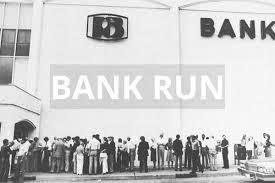
A bank run happens when many customers rush to take their money out of a bank at the same time because they’re worried the bank might fail. The fear spreads quickly, and as more people withdraw their funds, the bank can run out of cash—even if it was financially healthy to begin with.
In many cases, it’s panic, not actual financial trouble, that triggers a bank run. Unfortunately, that panic can become a self-fulfilling problem and push a bank into collapse.
How a Bank Run Starts
Banks don’t keep all customer deposits in cash. Instead, they:
-
Hold a small amount of cash for daily withdrawals
-
Lend most deposits out as mortgages, business loans, or other credit
This system works fine under normal conditions. Problems arise when too many people want their money back at once.
A Simple Example
Imagine a bank has $1 billion in customer deposits. Only a fraction of that money is immediately available as cash. If customers suddenly try to withdraw hundreds of millions of dollars in a short time, the bank may not be able to keep up—even if it owns valuable assets.
As word spreads that withdrawals are slowing or limited, fear grows. That fear causes even more people to pull their money, making the situation worse.
Why Fear Matters More Than Reality
Most bank runs aren’t caused by confirmed insolvency. Instead, they happen because people believe a bank might fail.
When customers panic:
-
Banks may be forced to sell assets quickly
-
Assets sold in a hurry often fetch lower prices
-
Losses weaken the bank’s financial position
This cycle can turn fear into reality.
Famous Examples of Bank Runs
The Great Depression
In the early 1930s, thousands of U.S. banks failed after waves of customers withdrew their savings following the stock market crash. At the time, there was no deposit insurance, so people had every reason to panic.
Silicon Valley Bank (2023)
In March 2023, Silicon Valley Bank experienced one of the fastest bank runs in history. After concerns about its finances surfaced, customers attempted to withdraw tens of billions of dollars within days—mostly through electronic transfers. Regulators stepped in and shut the bank down.
Washington Mutual and Wachovia (2008)
During the financial crisis, both banks faced massive withdrawals driven by fear and uncertainty. In each case, depositors pulled billions of dollars in a short period, leading to government intervention and acquisitions by larger banks.
What Is a Silent Bank Run?
Not all bank runs involve lines outside a branch.
A silent bank run happens when customers move money electronically instead of withdrawing cash in person. This includes:
-
Wire transfers
-
ACH transfers
-
Online withdrawals
Silent bank runs can spread faster because large amounts of money can leave a bank in minutes with a few clicks.
Why Bank Runs Are Dangerous
Bank runs can:
-
Cause banks to fail suddenly
-
Spread fear to other banks
-
Trigger broader financial instability
Since banks are interconnected, trouble at one institution can make customers question others—even strong ones.
How Bank Runs Are Prevented Today
After the Great Depression, the U.S. put safeguards in place to protect consumers and reduce panic.
FDIC Deposit Insurance
The Federal Deposit Insurance Corporation (FDIC) insures deposits at most U.S. banks:
-
Up to $250,000 per depositor, per bank, per account type
-
Protects checking, savings, and CDs
This insurance reassures customers that their money is safe, even if a bank fails.
Government Intervention
In extreme situations, regulators may:
-
Temporarily close banks
-
Arrange emergency funding
-
Facilitate acquisitions by stronger institutions
In rare cases, deposit coverage has been extended to protect customers and stabilize the system.
How to Protect Yourself From a Bank Run
For everyday consumers, protection is simple:
-
Keep deposits within FDIC limits
-
Spread large balances across multiple banks if needed
-
Confirm your bank is FDIC-insured
-
Avoid reacting to rumors or social media panic
For most people, FDIC insurance means bank runs won’t affect their savings.
Why Banks Don’t Just Keep All the Cash
If banks kept all deposits in cash:
-
Loans would be scarce
-
Mortgages and business credit would be harder to get
-
Economic growth would slow
The modern banking system relies on trust, regulation, and safeguards to function smoothly.
The Bottom Line
A bank run happens when fear causes many customers to withdraw money at once, potentially overwhelming even a stable bank. While bank runs were once common and devastating, today’s system is much safer thanks to deposit insurance and government oversight.
For most Americans, keeping money in an FDIC-insured bank—and staying within coverage limits—means their savings are well protected, even during periods of financial stress.